

Investment Growth Calculator: See How Your Money Can Grow Over Time



Projections generated are hypothetical and not a guarantee of future results. All investments carry some level of risk, including the potential loss of principal invested. Read important information here.
The goal of any investment is to get more cash out than you put in. Thanks to compounding returns, the longer you leave your money invested, the higher your potential returns could be.
Investment details
Total Contributions
$0Interest Earned
$0Best Credit Cards 2026
Find the Best Credit Card for Your Needs
Compare top credit cards, cashback offers, rewards and choose the best one for you.
Initial Investment: The amount of money you start the investment with – Example:
- $5000 means you start with $5,000.
Years of Investment Growth: The time period for which you keep your money invested – Example:
- 30 means the time period of 30 years in which you keep $5000 invested.
Estimated Rate of Return: The yearly percentage-based return that you expect from your investment – Example:
- 6% means around 6% of yearly return you expect from your investment of $5000
Typical averages:
- Savings accounts → 2–4%
- Mutual funds/index funds → 7–12%
- Stocks → vary a lot
Want to understand how compounding works in detail? Try our Compound Interest Calculator to see how your money can grow faster over time through compounding.
Compound Frequency: This is how often your investment returns are added back to your balance, helping your money grow faster through compounding. For most investments like stocks or ETFs, daily or monthly compounding is commonly used – Example:
- If your investment earns returns daily, those earnings start generating their own returns sooner compared to yearly compounding.
Amount of Recurring Investments: If you’re planning to invest on a regular basis/monthly/yearly, enter the amount you plan to invest going forward.
What is “GOOD RETURN”
When we talk about what is a “GOOD RETURNS” then most people think the higher the better but in reality returns can vary based on many factors such as what you are invested in and how the overall economy and industries are performing. You can’t expect similar returns even though the type of investment is the same.
Typical Long-Term Investment Returns
- S&P 500: Around 10% average annual return historically.
- High-Yield Savings Accounts: Usually around 3% to 4%+.
- Bond Funds: Typically around 3% to 4% for U.S. government bonds.
- CDs (Certificates of Deposit): Often around 3% to 4%+, depending on the term length.
Investments are divided into assets and the most common assets are – stocks, bonds, and commodities
- Stocks: Stocks are shares – you own a small part of a company. They are also known as equities. Mostly investors expect to earn higher returns through equities over long-term investments and equities can be very volatile in short-term investments.
- Bonds: In this Investors lend money to corporations or governments. The investor earns regular interest on the lent amount while the corporations or governments perform the operations through the funded amount. Generally, riskier bonds — such as corporate bonds — tend to offer higher returns compared to safer options like U.S. government bonds.
- CDs: Certificates of deposit (CDs) are low-risk saving investments in which you save money/deposit where you earn a set rate of return on the deposited amount for a particular time period. The downside is that most CDs charge an early withdrawal penalty if you take your money out before the time period ends. Example: Suppose you deposit $5,000 into a 1-year CD with a 4% interest rate. After 1 year, your money grows to about $5,200.
- Funds (Mutual & Index): Fund investments are pooled investments where money from many investors is combined into different assets like stocks or bonds. Funds allow investors to buy different assets in one single investment. They are managed by professional fund managers whose goal is to earn higher returns through the market
- ETFs: Exchange-traded funds (ETFs) are investment funds that contain a mix of assets like stocks or bonds, similar to mutual funds and index funds. However, ETFs trade on stock exchanges just like regular stocks, meaning investors can buy or sell them throughout the trading day.
- If you also want to maximize cashback and travel rewards from everyday spending, explore our Best Credit Cards Guide to compare cashback, travel, and rewards cards.
- Real estate: Real estate investments don’t only mean investing in properties as though it is a physical way to earn returns in the long term. But some investors invest through Real Estate Investment Trusts (REITs). REITs are companies that own and manage real estate properties such as shopping malls, office buildings, hotels, or apartment complexes.
- Commodities: commodity investments are investments in raw goods such as oil, agriculture, gold, metals and livestock. Investors use commodities to diversify their portfolios or protect against inflation.
All investments come with a risk no matter in which bonds, stocks or commodities you invest. So the best way to reduce the risk is by investing through diversification.
Diversification means spreading your money on different types of investments instead of investing everything in one. This helps reduce the impact if one investment performs poorly.
This way, if one investment loses value, other investments in your portfolio may still perform well and help balance the risk.
The information and calculations provided by this Investment Calculator are for educational and informational purposes only and should not be considered financial, investment, tax, or legal advice.
All projected returns shown are hypothetical estimates based on the numbers entered by the user and do not guarantee future performance or investment results.
Actual investment returns may vary significantly due to market conditions, inflation, interest rate changes, fees, taxes, economic events, and investment risks.
Past performance does not guarantee future results. All investments carry risk, including the possible loss of principal.
This calculator does not account for investment management fees, taxes, inflation, trading costs, or changes in contribution amounts unless specifically stated.
Global Finance US does not provide personalized financial advice or investment recommendations. Users should consult a licensed financial advisor, tax professional, or legal expert before making financial decisions.
By using this calculator, you acknowledge that all financial decisions are made at your own discretion and risk.
Must Reads
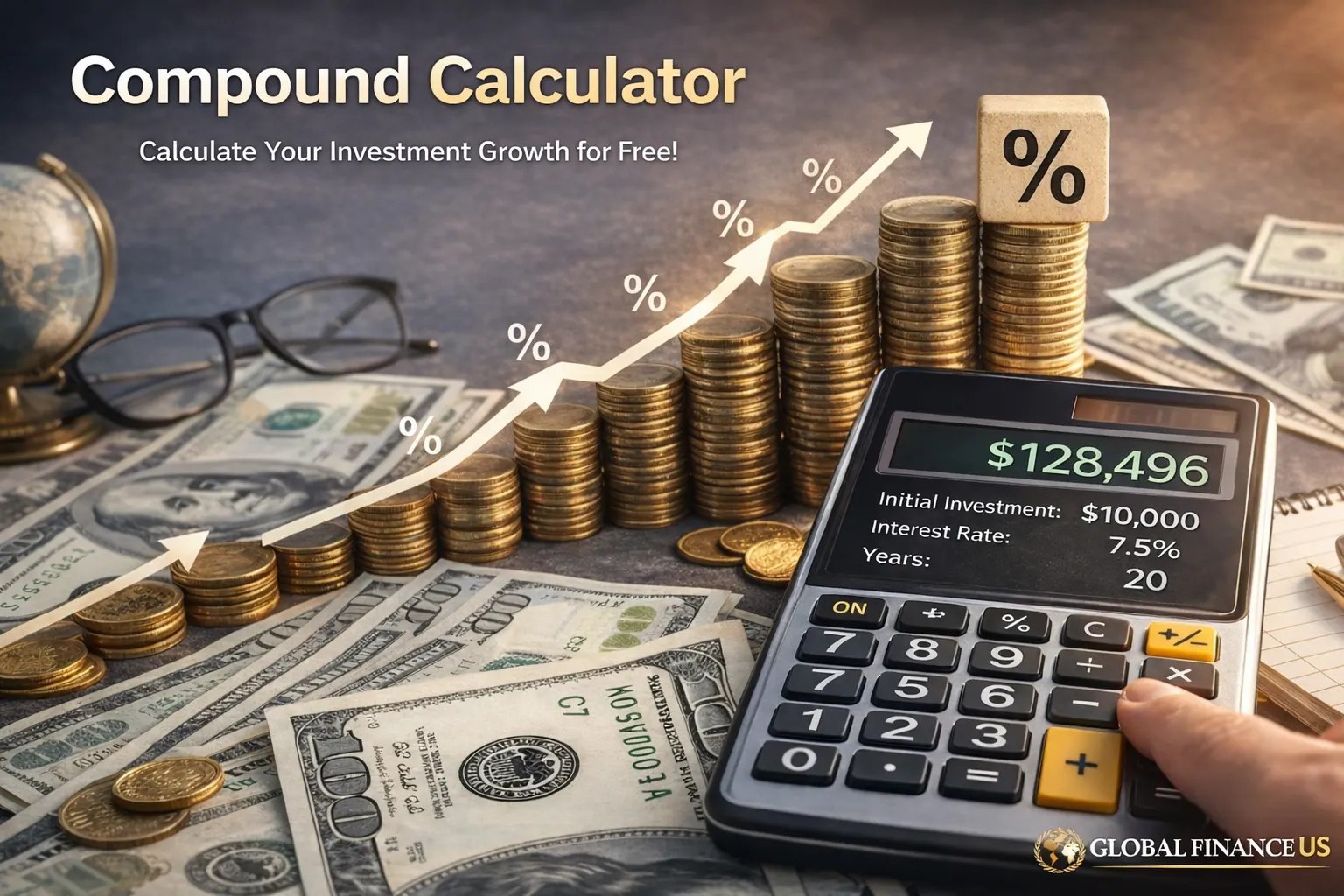
💰Compound Interest Calculator (Free & Fast)
Take control of your financial future with our powerful Compound Interest Calculator — the smart finance tool trusted by savvy investors across the USA.
Read More
Retirement Calculator USA: Estimate Savings & Income Easily
Calculate how much you need to retire comfortably with our free Retirement Savings Calculator.
Read More
Compare Best Credit Cards USA 2026 – Cashback & Travel
Easily compare top US credit cards for cashback, travel rewards, and 0% APR deals.
Read More